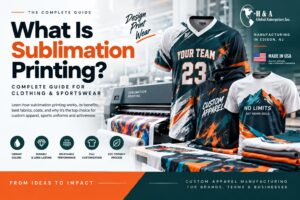
What Is Sublimation Printing? Complete Guide for Clothing & Sportswear
Sublimation printing is a digital decoration process that uses heat to turn specially formulated dye into a gas and bond it with compatible synthetic fibers, most commonly polyester. Instead of leaving a thick layer of ink on top of the garment, the color becomes part of the fabric. The result is a lightweight, smooth print that can reproduce detailed artwork, gradients, names, numbers, logos, and all-over graphics.
That combination makes dye sublimation especially useful for performance apparel. Sports teams can build fully customized uniforms without adding a heavy print layer, while apparel brands can create bold, repeatable designs across jerseys, shorts, activewear, and other polyester-based garments.
| Quick answer Sublimation is best suited to polyester and other compatible synthetic materials. It is particularly strong for full-color sportswear and all-over designs because the decoration is embedded into the fabric rather than applied as a raised surface layer. |
How Does Dye Sublimation Printing Work?
The exact production workflow varies by manufacturer and garment, but a typical sublimated apparel project moves through several connected stages.
1. Artwork and garment design
The process starts with the garment design. Team colors, logos, player names, numbers, sponsor marks, patterns, gradients, and other graphics are arranged on digital garment panels. For cut-and-sew uniforms, artwork must line up with the actual pattern pieces so important design elements remain correctly positioned after sewing.
2. Printing the transfer
The approved artwork is printed with sublimation dyes onto transfer paper. This is not the finished garment print. The transfer is an intermediate step that allows the design to be moved into the fabric under controlled heat and pressure.
3. Heat transfer into the fabric
The printed transfer and compatible fabric are exposed to heat and pressure. Under the right conditions, the sublimation dye changes state and penetrates the polyester fibers. As the material cools, the color remains locked into the fibers.
4. Cutting and sewing
For fully custom garments, printed fabric panels are cut according to the approved pattern and then sewn together. This is what makes true all-over customization possible: the design can extend across the garment rather than being limited to a small print area on a finished blank.
5. Quality control and finishing
Finished garments should be checked for color consistency, print placement, stitching, sizing, numbering, logos, and other order-specific details before packing and delivery. For team orders, roster accuracy is particularly important because a single incorrect name or number can make an otherwise good uniform unusable.
What Fabrics Are Best for Sublimation Printing?
Polyester is the standard fabric for sublimation because the dye is designed to bond with synthetic polyester fibers. In general, the more suitable polyester content a fabric has, the more reliably it can reproduce vibrant sublimated color.
Polyester
Performance polyester is a natural fit for team jerseys, training wear, activewear, and many athletic garments. It can be engineered for moisture management, stretch, breathability, mesh ventilation, and different weights while remaining compatible with sublimation.
Polyester blends
Some polyester blends can also be sublimated, but the final appearance depends on the blend composition. Fibers that do not accept sublimation dye in the same way can create a softer or more heathered result. Brands should test the actual fabric before approving production when exact color reproduction is important.
Why cotton is different
Traditional dye sublimation is not designed to bond directly with natural cotton fibers in the same way it bonds with polyester. If a project requires cotton or cotton-rich garments, another decoration method such as DTF, screen printing, or embroidery may be more appropriate depending on the artwork and use case.
Light vs. dark garments
Sublimation dyes are transparent rather than opaque. That is why the process performs best when the base material is white or light enough for the transferred colors to show correctly. With fully custom cut-and-sew manufacturing, the fabric can be sublimated before assembly, allowing the finished garment to appear dark, bright, patterned, or multi-colored even though the printable base fabric started light.
Why Is Sublimation Popular for Sportswear?
Sports uniforms combine demanding visual requirements with demanding physical use. Teams want strong branding and individualized rosters, but athletes also need garments that remain comfortable during movement. Sublimation addresses both sides of that requirement.
- Full-color customization: gradients, patterns, photographic elements, team colors, logos, names, numbers, and sponsor graphics can be incorporated into one design.
- No heavy print layer: because the color is embedded into compatible fibers, large graphics do not create the same thick surface feel as some applied decoration methods.
- All-over design freedom: cut-and-sew sublimation allows graphics to extend across garment panels instead of staying inside a small print box.
- Roster personalization: names and numbers can be built into individual player artwork before production.
- Performance use: polyester fabrics are widely used in sportswear because they can be selected for breathability, moisture management, stretch, and durability.
What Types of Clothing Can Be Sublimated?
Sublimation is most useful when the garment and fabric have been selected with the process in mind. Common applications include:
- Custom team jerseys and uniforms
- Basketball, football, baseball, softball, soccer, lacrosse, and esports apparel
- Shorts and training bottoms
- Performance t-shirts and warm-up tops
- Activewear and gym apparel
- Compression and performance garments made from suitable synthetic fabrics
- Selected accessories and promotional textile products that are manufactured for sublimation
Not every product should automatically be sublimated. The best decoration method depends on the fabric, design coverage, desired texture, quantity, end use, and budget.
Sublimation vs. Screen Printing
Screen printing applies ink to the surface of a garment through screens, while sublimation dyes compatible synthetic fibers. Screen printing can be a strong choice for many cotton and blended garments, especially when the artwork uses a limited number of colors. Sublimation becomes particularly attractive for polyester sportswear when the design uses many colors, gradients, repeated personalization, or all-over graphics.
Sublimation vs. DTF
Direct-to-film (DTF) printing transfers a printed graphic onto the surface of a garment using an adhesive system. It can work across a wider range of garment colors and fabric types than traditional sublimation. Sublimation, however, has no raised transfer layer on compatible polyester and is well suited to full-garment sports designs.
Related H&A guide: Embroidery vs. Sublimation vs. DTF: Which Printing Method Is Right for Your Team Gear?
Sublimation vs. Embroidery
Embroidery uses thread to stitch logos, names, or other artwork into the garment. It creates a textured, premium appearance and works especially well for caps, polos, jackets, corporate apparel, and smaller brand marks. Sublimation is usually the stronger option when a polyester jersey needs large, detailed, multi-color graphics across substantial areas of the garment. Many apparel programs use both methods across different products.
How Durable Is Sublimation Printing?
On the right fabric and with a properly controlled production process, sublimation is highly durable because the color is incorporated into the polyester fibers. There is no conventional vinyl-like layer sitting on top of the fabric to crack or peel.
Durability still depends on more than the printing method. Fabric quality, dye and transfer quality, heat settings, garment construction, washing, exposure, and general use all affect how a product performs over time.
Does Sublimation Crack, Peel, or Fade?
A properly sublimated design should not crack or peel in the way a separate surface film can, because there is no thick applied layer to separate from the fabric. Color can still change over a garment’s life due to wear, repeated laundering, prolonged environmental exposure, or poor production control, so it is better to describe sublimation as highly durable rather than literally indestructible.
What Are the Advantages of Sublimation Printing?
- Detailed full-color graphics and gradients
- All-over garment design possibilities
- Smooth hand feel on compatible fabric
- Names, numbers, and logos can be incorporated into the artwork
- Strong durability on properly produced polyester apparel
- Excellent fit for performance uniforms and activewear
What Are the Limitations of Sublimation?
- It is primarily suited to polyester and compatible synthetic materials.
- Traditional sublimation is not the best direct-print solution for cotton-rich garments.
- The transparent dyes work best with a light printable base.
- Color management and production control matter when teams need repeatable brand colors.
- Complex cut-and-sew designs require accurate pattern setup and panel alignment.
How Much Does Sublimation Printing Cost?
There is no single useful price for every sublimation project because manufacturing cost depends on the complete garment specification. A basic transfer onto a standard item is different from a fully custom cut-and-sew uniform built from printed panels.
Common cost factors include:
- Order quantity
- Garment type and pattern complexity
- Fabric type, weight, stretch, and performance properties
- Cut-and-sew requirements
- Individual player names and numbers
- Sampling and development
- Labels, packaging, and other private-label requirements
- Production location, turnaround requirements, and shipping
For brands and teams, the most useful quote is therefore based on a defined product, quantity, fabric, customization level, and target delivery date rather than a generic per-print price.
Is Sublimation Good for Small Clothing Brands?
It can be. Sublimation allows a new brand to create visually distinctive polyester products without restricting the artwork to a few spot colors. It is particularly useful for performance-oriented collections, sportswear, teamwear, and graphic-heavy designs.
A small brand should still evaluate minimum order quantities, sample costs, fabric availability, pattern development, labels, packaging, repeat-order consistency, and the manufacturer’s ability to scale. The printing method is only one part of building a reliable product.
Is Sublimation Good for Sports Teams?
Sports teams are one of the clearest use cases for sublimation. A single uniform design can combine team branding, multiple colors, player names, numbers, sponsors, patterns, and other graphics while preserving a smooth surface on compatible performance fabric.
Teams should pay particular attention to sizing, roster accuracy, color consistency, reorder procedures, and delivery deadlines. Those operational details matter as much as the artwork when uniforms must be ready before a season starts.
For a local manufacturing example, see: Custom Football Uniform Manufacturer in New Jersey
How to Choose a Sublimation Clothing Manufacturer
A manufacturer should be evaluated on more than whether it owns a sublimation printer. For fully custom apparel, printing must work together with design preparation, fabric sourcing, pattern making, cutting, sewing, quality control, and order management.
Before placing an order, ask:
- Do you manufacture the garment or only decorate finished blanks?
- Which fabrics do you recommend for my specific use case?
- Can you provide a sample or pre-production approval?
- How do you manage color consistency and repeat orders?
- Can names, numbers, logos, and sponsor marks be individualized?
- What is the minimum order quantity for this product?
- What production lead time applies to my actual order?
- Do you handle cut and sew, labels, packaging, embroidery, or other services in addition to sublimation?
- What quality-control checks are completed before shipping?
Sublimation Manufacturing in the USA
For U.S. brands and teams, domestic manufacturing can be useful when communication, production visibility, sampling, and delivery planning are important. The right choice still depends on product requirements, price, capacity, timeline, and the capabilities of the individual manufacturer.
H&A Global Enterprises provides custom apparel manufacturing from its facility in Edison, New Jersey. Its capabilities include sublimation printing, cut-and-sew manufacturing, embroidery, private labeling, and sportswear production.
Explore H&A’s commercial service page: Sublimation Printing Manufacturer
| Planning a custom sublimation project? Share your garment type, estimated quantity, artwork requirements, target delivery date, and any private-label needs with H&A Global Enterprises to discuss the right production approach for your project. |
Request a quote / contact H&A Global Enterprises
Frequently Asked Questions About Sublimation Printing
Is sublimation printing permanent?
Sublimation dye becomes part of compatible polyester fibers rather than forming a thick layer on top. That makes it highly durable, although the garment can still show normal wear and color change over a long service life.
Can you sublimate cotton?
Traditional sublimation is designed for polyester and compatible synthetic surfaces, not untreated cotton fibers. Cotton-rich garments usually require a different decoration method or a specialized workaround.
Can sublimation be used on dark clothing?
Sublimation dyes are transparent, so they need a light printable base. Fully custom garments can still have a dark finished appearance because the light fabric is printed before the garment is cut and assembled.
What percentage of polyester is best for sublimation?
Higher compatible polyester content generally produces stronger sublimation results. The exact fabric should be tested when color accuracy and performance are important, especially with blends.
Does sublimation fade after washing?
Properly produced sublimation is highly wash-resistant because the dye is embedded in compatible fibers. Fabric quality, process control, laundering, and long-term use can still influence appearance.
Is sublimation better than screen printing?
Neither method is universally better. Sublimation is especially strong for full-color polyester sportswear and all-over graphics, while screen printing can be a better fit for many cotton garments and simpler spot-color designs.
Is sublimation suitable for sports jerseys?
Yes. Polyester sports jerseys are one of the most common applications because sublimation supports detailed full-color designs, names, numbers, logos, and lightweight performance garments.
What is the difference between sublimation and DTF?
Sublimation dyes compatible fibers, while DTF transfers a printed graphic onto the garment surface. DTF supports a wider range of fabrics and garment colors, while sublimation is particularly well suited to polyester performance apparel and all-over designs.
Final Takeaway
Sublimation printing is one of the most flexible decoration methods for polyester clothing and performance sportswear. Its biggest strengths are full-color design freedom, all-over customization, a smooth hand feel, and strong durability when the process is properly controlled.
The best results come from treating sublimation as part of the complete garment-manufacturing process. Fabric selection, pattern development, artwork setup, cutting, sewing, quality control, and reliable production planning all determine whether a design becomes a successful finished product.