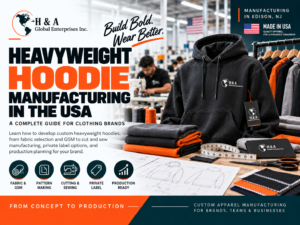
The demand for premium heavyweight hoodies has changed how clothing brands approach apparel manufacturing. A hoodie is no longer just a comfortable layering piece. For streetwear labels, lifestyle brands, merchandise businesses, and private-label clothing companies, it can become a signature product that defines the identity of an entire collection.
Consumers increasingly look beyond logos and graphics. They notice fabric weight, garment construction, oversized silhouettes, stitching, texture, fit, and finishing. These details separate an ordinary sweatshirt from a thoughtfully developed premium garment.
For clothing brands, however, creating a heavyweight hoodie involves more than selecting a thick fabric and adding a logo.
Successful heavyweight hoodie manufacturing requires the right combination of fabric weight, material composition, custom pattern development, construction quality, decoration, sampling, and production planning.
Whether you are developing your first 25–50 pieces or preparing for a larger product launch, understanding these elements will help you communicate your requirements, avoid unnecessary development costs, and create apparel that reflects your brand’s standards.
At H&A Global Enterprises, we support apparel brands with custom cut-and-sew manufacturing, product development, private labeling, embroidery, and garment decoration from our facility in Edison, New Jersey.
This guide explains what you should know before manufacturing heavyweight hoodies in the USA.
1. What Is a Heavyweight Hoodie?
A heavyweight hoodie is a hooded sweatshirt made using fabric with a relatively high weight per unit area, often designed to provide a substantial feel, warmth, structure, and a distinctive silhouette.
Unlike lightweight sweatshirts, heavyweight hoodies are commonly developed for premium streetwear, cold-weather collections, luxury casualwear, and branded apparel where fabric weight is part of the product’s appeal.
However, the term heavyweight is not defined by one universal industry threshold.
A manufacturer may describe a 350 GSM hoodie as heavyweight, while a premium streetwear brand may prefer 450 GSM or even 500 GSM.
The ideal specification depends on the garment’s intended use, construction, fit, and customer expectations.
Characteristics of premium heavyweight hoodies
Common features include:
- Substantial fabric that provides a structured appearance
- Premium cotton or cotton-blend materials
- Oversized, relaxed, or boxy silhouettes
- Ribbed cuffs and waistbands with good shape recovery
- Carefully constructed hoods and reinforced seams
- High-quality embroidery or screen printing
- Custom neck labels, woven labels, and packaging
- Optional garment-washed, faded, or distressed finishes
Not every premium hoodie needs all these features. The goal is to select materials and construction details that work together to create a consistent product.
For example, a minimalist luxury hoodie might use thick cotton fleece, a clean boxy silhouette, subtle embroidery, and understated labels.
A streetwear hoodie might use the same fabric weight but incorporate a washed finish, oversized sleeves, bold graphics, and custom hardware.
Both can qualify as premium products, even though their visual identities are completely different.
2. Understanding GSM in Hoodie Manufacturing
One of the most important terms in custom hoodie development is GSM, which stands for grams per square meter.
GSM measures fabric weight by identifying how many grams one square meter of fabric weighs.
For example:
- A 300 GSM fabric weighs 300 grams per square meter.
- A 400 GSM fabric weighs 400 grams per square meter.
- A 500 GSM fabric weighs 500 grams per square meter.
As GSM increases, fabric generally becomes more substantial. However, GSM measures weight rather than quality, and heavier does not automatically mean softer, stronger, or more luxurious.
Fiber quality, knitting construction, yarn characteristics, finishing, and garment design all influence the final result.
Hoodie fabric weight comparison
| Fabric Weight | General Classification | Common Applications |
|---|---|---|
| 280–340 GSM | Midweight | Everyday hoodies, casualwear, promotional apparel |
| 350–399 GSM | Mid-heavy to heavyweight | Premium casualwear, structured sweatshirts |
| 400–449 GSM | Heavyweight | Streetwear, cold-weather apparel, premium collections |
| 450–500 GSM | Very heavyweight | Luxury streetwear, oversized hoodies, statement pieces |
| Above 500 GSM | Extra-heavyweight | Specialty apparel with substantial structure |
These are practical comparison ranges, not formal universal manufacturing standards.
Is 400 GSM good for hoodies?
Yes. A well-constructed 400 GSM hoodie can provide a substantial feel while remaining suitable for everyday use.
For brands developing premium apparel, 400 GSM is often a useful starting point for evaluating heavyweight fabrics.
It can work well for:
- Premium branded hoodies
- Streetwear collections
- Pullover sweatshirts
- Custom embroidered hoodies
- Matching hoodie and sweatpants collections
The final comfort level depends on fabric composition, interior finish, garment fit, and intended climate.
Is 450 GSM better than 400 GSM?
Not necessarily.
A 450 GSM fabric has more weight per square meter, but that does not guarantee better quality.
A well-developed 400 GSM cotton fleece may feel softer and perform better than a poorly constructed 450 GSM alternative.
The decision should depend on what your brand wants customers to experience.
If your objective is a more structured oversized silhouette, 450 GSM may be worth testing.
If you want a substantial hoodie that remains comfortable for regular wear, 400 GSM may already meet your requirements.
What about 500 GSM hoodies?
A 500 GSM hoodie is a specialized heavyweight garment.
This weight can create a pronounced, substantial appearance and may appeal to brands seeking an especially structured streetwear aesthetic.
However, extra-heavyweight fabric introduces additional considerations:
- Greater garment weight
- Increased material consumption
- More demanding sewing and construction requirements
- Potentially higher shipping costs
- Reduced comfort in warmer climates
- Different shrinkage and drying characteristics
Before committing to 500 GSM production, request a fabric sample and evaluate a finished prototype.
Our recommendation: Choose GSM based on the garment’s intended fit, feel, appearance, and end use—not simply because a higher number sounds more premium.
3. Best Fabrics for Premium Heavyweight Hoodies
Fabric composition plays a major role in how a hoodie feels, performs, prints, washes, and maintains its shape.
Two hoodies with identical GSM ratings can feel completely different because of their fiber composition and knit construction.
100% cotton fleece
Cotton fleece is a popular choice for premium casualwear and streetwear.
It offers a natural hand feel and can provide excellent comfort when properly selected and finished.
Advantages:
- Natural fiber feel
- Good comfort and breathability
- Suitable for many embroidery and printing applications
- Attractive texture for premium apparel
- Options for different knit and finishing treatments
Considerations:
Cotton garments can shrink during washing, especially if the fabric has not been properly stabilized.
Brands should evaluate fabric shrinkage, colorfastness, surface quality, and pilling performance during development.
Cotton-polyester blends
Cotton-polyester fleece combines characteristics of both fibers.
Depending on the composition and construction, these blends can improve dimensional stability, reduce some shrinkage concerns, and provide different drying and care characteristics.
Common blend ratios include 80/20, 70/30, and 60/40 cotton-to-polyester.
However, these percentages are examples of available fabric compositions, not a recommendation that every project should use one of them.
The best blend depends on your priorities.
A cotton-rich blend may be preferable when a natural hand feel is central to your brand.
A blend with more polyester may be appropriate when easy care, specific performance characteristics, or cost considerations take priority.
French terry
French terry typically features a smooth outer surface and loops on the inside.
It can produce a comfortable, structured garment without the same brushed interior feel associated with traditional fleece.
It is worth considering for:
- Premium casualwear
- Transitional-weather collections
- Relaxed-fit hoodies
- Minimalist streetwear
- Matching sweatshirts and joggers
French terry is available in different fabric weights and fiber compositions.
Brushed fleece
Brushed fleece has a raised, soft interior surface.
It is commonly selected for hoodies intended to feel warm, plush, and comfortable.
The brushing process affects the fabric’s interior texture, but the final result depends on the yarn, knit, and finishing quality.
For heavier fleece garments, evaluate softness, pilling resistance, interior shedding, and dimensional stability.
How to choose your fabric
Before selecting a fabric, answer these questions:
- Will the hoodie be worn primarily in cold weather or throughout the year?
- Do you want the garment to hold a boxy shape or drape naturally?
- Is a soft brushed interior essential?
- Are you planning large screen-printed graphics or detailed embroidery?
- Will the garment have a washed or distressed finish?
- What is your target retail price?
- What level of shrinkage is acceptable?
- What care instructions will the final garment require?
A fabric swatch is useful, but a finished hoodie sample provides a much better picture of how the fabric performs in your intended design.
4. Custom Cut-and-Sew vs. Blank Hoodie Customization
One of the most important decisions is whether your brand needs a hoodie manufactured from scratch or an existing blank garment decorated with your branding.
These approaches serve different purposes.
Blank hoodie customization
Blank garment customization starts with an existing hoodie.
Your brand then adds graphics, embroidery, labels where practical, or other decoration.
This approach may work for businesses that need promotional merchandise or want to test branding concepts without creating a new garment pattern.
However, customization is limited by the original hoodie’s fabric, fit, dimensions, and construction.
Custom cut-and-sew hoodie manufacturing
Custom cut-and-sew production involves developing the garment around your specifications.
Instead of accepting a pre-existing silhouette, you can define important construction elements, such as:
- Body length and width
- Shoulder placement
- Sleeve length and shape
- Hood dimensions
- Pocket construction
- Ribbing dimensions
- Seam placement
- Fabric composition
- Garment measurements and grading
This approach is particularly valuable for brands developing a distinctive fit or signature clothing collection.
For example, if your product concept calls for an oversized 450 GSM hoodie with dropped shoulders, a shorter body, wider sleeves, and a double-layer hood, custom pattern development gives you more control over the finished result.
Which option should a startup choose?
Blank customization may be appropriate when your priority is to test a logo or design on an established garment.
Custom cut-and-sew manufacturing is often the better option when the garment itself is a key part of the brand’s identity.
At H&A Global Enterprises, our cut-and-sew manufacturing services support custom pattern making, fabric cutting, garment assembly, decoration, and quality control.
5. Designing an Oversized Heavyweight Hoodie
An oversized hoodie is not simply a standard hoodie manufactured two sizes larger.
A successful oversized silhouette requires deliberate pattern development.
If every dimension is increased without considering the garment’s proportions, the result may feel poorly fitted rather than intentionally relaxed.
Dropped shoulders
Dropped shoulders position the shoulder seam below the wearer’s natural shoulder line.
This creates a relaxed appearance commonly associated with modern streetwear.
However, the amount of shoulder drop should be carefully balanced against sleeve width and overall garment length.
Boxy fit
A boxy hoodie typically uses a wider body with proportions that produce a squared, structured silhouette.
Some brands combine a generous body width with a relatively shorter length.
Others prefer a longer relaxed fit.
Neither approach is universally better; the choice depends on the desired visual identity.
Sleeve construction
Sleeve dimensions influence movement and appearance.
Brands may request wider sleeves, more generous armholes, ribbed cuffs, or specific seam placements.
A high-quality sample helps evaluate how these elements work together.
Hood design
The hood is a prominent feature of the garment.
Considerations include:
- Single-layer or double-layer construction
- Hood opening dimensions
- Hood depth
- Drawstrings or a clean drawstring-free design
- Matching or contrasting interior fabric
- Seam placement and shape
A double-layer hood may create a more substantial appearance but also uses additional fabric.
Waistband and cuffs
Ribbed cuffs and waistbands influence both the visual finish and the garment’s ability to retain its shape.
The rib fabric should complement the main body fabric in weight, stretch, recovery, and appearance.
Pattern grading
Once a base sample has been approved, the pattern must be graded for additional sizes.
Proper grading is particularly important for oversized apparel because the proportions should remain intentional across the size range.
A hoodie that looks correctly oversized in medium should not become disproportionately long or narrow in larger sizes.
6. Custom Branding Options for Heavyweight Hoodies
Premium hoodie manufacturing often involves combining more than one decoration or branding method.
The right approach depends on your artwork, fabric, desired finish, and budget.
Embroidery
Embroidery uses stitching to create logos, text, or decorative elements.
It is commonly used for premium chest logos, sleeve branding, and subtle visual details.
Embroidery can create a textured appearance, but very dense or oversized embroidered artwork may affect how the garment drapes.
A sample helps determine the appropriate stitch density, placement, backing, and finish.
Learn more about custom embroidery manufacturing.
Screen printing
Screen printing is a popular choice for streetwear graphics.
It can be suitable for larger front or back prints, bold colors, typography, and many repeat-production applications.
Pricing and feasibility depend on factors including artwork complexity, number of print colors, garment color, print size, and order quantity.
Brands should also consider the desired hand feel, whether soft or deliberately textured.
Direct-to-film printing
Direct-to-film, or DTF, printing transfers printed artwork onto garments.
It can be useful for detailed, multi-color graphics and certain smaller production runs.
However, the print’s hand feel, stretch behavior, and wash durability should be evaluated on the actual hoodie fabric before production approval.
Private labels and woven branding
Private labeling allows your finished garments to carry your own brand identity.
Common details include:
- Custom neck labels
- Woven brand labels
- Size labels
- Care and fiber-content labels
- Custom hangtags
- Branded packaging
These elements help transform a manufactured garment into a cohesive retail product.
Your brand should also ensure that required textile labeling and country-of-origin information is accurate and compliant.
H&A Global Enterprises offers private-label apparel manufacturing to support brands developing their own collections.
7. Vintage Washes and Distressed Heavyweight Hoodies
Washed and distressed garments are particularly relevant to streetwear brands seeking a worn-in or vintage appearance.
The finishing process can change the garment’s color, surface texture, softness, and dimensions.
Popular visual directions include:
Garment washing: Washing a constructed garment to develop a particular look or feel.
Enzyme washing: Using controlled enzymatic treatments to alter certain fabric surfaces, particularly cotton-based materials.
Pigment-dyed or faded appearances: Creating softer, washed-looking colors through selected dyeing or finishing approaches.
Distressed graphics: Using printing techniques or artwork designed to create an aged appearance.
These techniques require careful planning.
Not every finish is compatible with every fabric composition or decoration method. Some treatments may affect shrinkage, color consistency, garment strength, or print durability.
If your brand wants washed black, vintage gray, faded cream, or another specific finish, provide reference photographs and define your expectations before production.
The availability of specialty washing or dyeing processes should be confirmed with your manufacturer for each project.
8. What Is the Minimum Order Quantity for Custom Heavyweight Hoodies?
MOQ stands for minimum order quantity.
This is the minimum number of garments a manufacturer agrees to produce under a specific set of requirements.
A single universal MOQ does not apply to every heavyweight hoodie project.
The minimum can depend on:
- Fabric availability
- Fabric weight and composition
- Custom dyeing requirements
- Number of colorways
- Pattern development
- Decoration method
- Labeling and packaging
- Production complexity
For example, a project involving a readily available fabric and one hoodie color may be easier to accommodate in a small quantity than an order requiring several custom-dyed colors.
Can you manufacture 25 heavyweight hoodies?
Small-batch production may be possible depending on the manufacturing method and specifications.
However, an order of 25 fully custom heavyweight hoodies may have a higher cost per unit because setup and development costs are spread across fewer garments.
Ask your manufacturer whether your proposed quantity is feasible before designing your launch around it.
What about 50 or 100 hoodies?
These quantities provide useful comparison points when requesting quotes.
A brand can ask for estimates at 25, 50, 100, and 250 pieces to understand how manufacturing costs change with order volume.
For example, the following is a quotation framework—not a list of H&A Global’s confirmed minimums:
| Quantity | Potential Use |
|---|---|
| 25 pieces | Small pilot run, if manufacturing requirements allow |
| 50 pieces | Initial product launch or limited collection |
| 100 pieces | Broader release with more inventory |
| 250 pieces | Larger production program or established demand |
When ordering multiple sizes and colors, ask whether the MOQ applies per style, per color, or to the total order.
That distinction can have a significant impact on your production plan.
9. How Much Does Heavyweight Hoodie Manufacturing Cost in the USA?
The cost of manufacturing a custom heavyweight hoodie depends on the actual product specification.
There is no reliable universal price for every 400 GSM, 450 GSM, or 500 GSM hoodie.
Two garments with the same fabric weight may have very different costs because of their materials, construction, decoration, and order quantities.
1. Fabric weight
Higher GSM generally increases fabric consumption by weight.
The relationship between GSM and cost is not perfectly linear, because fabric composition, sourcing, width, construction, and finishing also affect material pricing.
2. Fabric composition
Premium cotton, cotton-rich blends, and specialty fabrics may have different sourcing costs.
The fabric’s quality and availability matter as much as its fiber-content percentage.
3. Custom construction
A fully developed cut-and-sew hoodie may require original pattern development, size grading, sample adjustments, and specialized construction details.
A standard design with fewer custom elements generally requires less development work.
4. Printing and embroidery
Decoration costs depend on artwork complexity, size, placement, colors, production method, and quantity.
A small embroidered chest logo may involve a different cost structure from a large back print combined with sleeve embroidery.
5. Labels and packaging
Custom woven labels, hangtags, printed bags, and retail packaging may contribute to the total unit cost.
Some custom packaging components also have their own supplier minimum quantities.
6. Order quantity
Production volume affects how fixed setup costs are distributed.
Larger orders may offer improved unit economics, but brands should also consider inventory risk.
Ordering more garments is not automatically the best decision if demand has not been validated.
7. Sampling and development
Sampling allows brands to evaluate materials, construction, and fit before authorizing larger production.
Development costs may include pattern creation, sample materials, sewing, embroidery setup, printing setup, and revisions.
How to obtain an accurate hoodie manufacturing quote
Instead of asking only, “How much does a custom hoodie cost?”, provide a detailed manufacturing brief.
For example:
Product: Premium oversized heavyweight pullover hoodie
Fabric: Target 450 GSM cotton-rich fleece
Fit: Boxy, dropped shoulder
Colors: Washed black and gray
Decoration: Small embroidered chest logo and large screen-printed back design
Branding: Custom neck label, care label, hangtag
Quantities: Request quotes for 25, 50, 100, and 250 pieces
Sampling: One development sample before bulk production
This gives the manufacturer enough direction to discuss feasibility and prepare a more useful estimate.
Final pricing should be confirmed against approved specifications rather than generic online price ranges.
10. Why Sampling Matters Before Bulk Hoodie Production
Sampling is one of the most valuable steps in custom clothing manufacturing.
A digital mockup can communicate the intended appearance, but it cannot fully demonstrate fabric hand feel, weight, stitching, shrinkage, fit, or print performance.
Stage 1: Design review
The manufacturer reviews your artwork, technical specifications, garment references, and intended fit.
This stage helps identify missing measurements or construction details.
Stage 2: Fabric selection
Fabric options are evaluated based on composition, GSM, appearance, and performance requirements.
For heavyweight hoodies, consider asking to compare different fabric weights.
Stage 3: Pattern development
The garment pattern is prepared or adapted to the approved specifications.
This defines the shape and construction of the hoodie.
Stage 4: Sample manufacturing
A physical sample is made so that the brand can evaluate the garment.
The sample may require adjustments before approval.
Stage 5: Fit and quality evaluation
Inspect the sample carefully.
Check:
- Shoulder shape and placement
- Chest width and body length
- Sleeve length
- Hood construction
- Fabric thickness and softness
- Pocket construction
- Embroidery and print placement
- Ribbing recovery
- Stitch quality
- Garment measurements
Stage 6: Wash testing and approval
A well-planned sample review should also examine how the garment behaves after washing.
Check for unacceptable shrinkage, twisting, fading, pilling, or print deterioration.
Once the garment meets the agreed specifications, the brand can approve the production sample and move forward.
11. How to Start a Heavyweight Hoodie Brand in 2026
Launching a premium hoodie brand requires both creative direction and disciplined production planning.
The following approach can help keep your project organized.
Step 1: Define your customer
Are you targeting luxury streetwear buyers, university students, athletic lifestyle customers, or another audience?
Your customer influences fabric weight, garment fit, decoration, retail pricing, and seasonal demand.
Step 2: Develop your signature product
Instead of launching too many unrelated styles, consider developing one distinctive hoodie.
For example, you might begin with a heavyweight oversized pullover in two carefully selected colors.
A focused launch simplifies product development and inventory management.
Step 3: Determine your price positioning
Decide what customers should be willing to pay for your hoodie.
Work backward from your target retail price to estimate acceptable manufacturing, packaging, shipping, marketing, and operating costs.
Do not assume that a premium garment automatically guarantees a premium profit margin.
Step 4: Prepare a tech pack
A technical package helps communicate your requirements to a manufacturer.
It should include:
- Front and back sketches
- Key garment measurements
- Target fabric weight and composition
- Color references
- Branding placements
- Stitching details
- Size range
- Label instructions
- Packaging requirements
Step 5: Request fabric and production guidance
Discuss your product concept with a manufacturer before committing to a specific fabric or quantity.
A good manufacturing discussion should clarify feasibility, development requirements, costs, and production expectations.
Step 6: Approve your samples
Evaluate the physical garment, not just photographs.
Make necessary fit and construction revisions before production.
Step 7: Plan your launch quantity
Choose an initial quantity based on your budget, expected demand, and manufacturing requirements.
Small-batch production may reduce inventory exposure, while larger quantities can sometimes improve unit costs.
Step 8: Prepare for reorders
Maintain approved garment specifications, measurements, decoration files, and production references.
This documentation can help your manufacturer reproduce the intended product consistently for future orders.
12. Choosing a Heavyweight Hoodie Manufacturer in the USA
When searching for a heavyweight hoodie manufacturer in the USA, evaluate more than location or advertised pricing.
The right manufacturing partner should understand your requirements and communicate clearly about what can realistically be produced.
Questions to ask a potential manufacturer
Do you provide full cut-and-sew manufacturing?
Confirm whether the manufacturer can develop a custom garment pattern or only decorate existing blanks.
Can you source my required fabric weight?
Ask whether your target GSM and composition are available and whether a suitable substitute can be recommended.
Do you offer sampling?
Understand the development process, sample costs, revision policy, and approval requirements.
What is your MOQ?
Ask how minimum quantities change across fabrics, styles, colors, and decoration methods.
Can you provide private labeling?
Discuss labels, care instructions, branding, and packaging.
What are the expected production timelines?
Confirm development and bulk manufacturing lead times separately.
What quality checks are performed?
Ask how measurements, stitching, decoration, and finished garments are inspected.
Can you support repeat orders?
Discuss specification records, future fabric availability, and consistency between production runs.
Working with H&A Global Enterprises
H&A Global Enterprises is a custom apparel manufacturing company based in Edison, New Jersey.
We provide support for brands that need garment development, custom cut-and-sew production, private-label manufacturing, embroidery, and decoration.
Our manufacturing process is designed around reviewing project specifications, preparing samples, producing approved garments, and inspecting finished products.
We work with emerging brands as well as businesses with larger manufacturing requirements.
Whether you are preparing a heavyweight streetwear collection or exploring a new private-label apparel line, our team can review your concept and discuss the production options appropriate to your requirements.
For more information, explore our custom apparel manufacturing services.
13. Frequently Asked Questions About Heavyweight Hoodie Manufacturing
What GSM is best for a premium heavyweight hoodie?
Many premium heavyweight hoodie concepts use fabrics around 400–500 GSM. However, the ideal fabric weight depends on the desired fit, comfort, construction, and customer expectations. Request samples before selecting a final specification.
Is a 500 GSM hoodie better than a 400 GSM hoodie?
Not automatically. A 500 GSM fabric is heavier, but garment quality also depends on fiber composition, yarn quality, knitting, finishing, and construction.
Can I manufacture heavyweight hoodies with my own brand label?
Yes. Private-label manufacturing can incorporate custom brand labels, care labels, hangtags, and packaging, subject to the production specifications and applicable labeling requirements.
Can I order only 25 or 50 custom heavyweight hoodies?
Small-batch manufacturing may be possible. Minimum quantities depend on fabric sourcing, customization, and production requirements. Contact the manufacturer for a project-specific MOQ.
Can I use embroidery and screen printing on the same hoodie?
Yes, combining decoration methods is possible when the fabric and design are compatible. The sample should be evaluated to confirm placement, hand feel, appearance, and performance.
What is the difference between fleece and French terry?
Brushed fleece typically has a raised, soft interior. French terry generally has unbrushed loops on the inside. Both are available in different compositions and weights, and either may be appropriate depending on the desired hoodie.
Can I create an oversized hoodie with my own measurements?
Yes. Custom cut-and-sew manufacturing allows brands to develop garment patterns around defined measurements and fit requirements.
How long does custom hoodie manufacturing take?
Timelines depend on fabric availability, sampling, development revisions, order quantity, decoration, and production scheduling. Sampling and bulk production should be discussed separately before setting a launch date.
Do I need a tech pack to manufacture custom hoodies?
A complete tech pack is strongly recommended because it reduces ambiguity. If you only have reference images or sketches, discuss whether the manufacturer offers assistance with product development and pattern creation.
Can I request a sample before placing a larger hoodie order?
Yes. H&A Global Enterprises offers sample production so brands can evaluate garments before authorizing bulk manufacturing. Sample charges and revision terms depend on the project.
14. Start Your Custom Heavyweight Hoodie Manufacturing Project With H&A Global Enterprises
A premium heavyweight hoodie begins with a clear product vision, but its success depends on how that vision is translated into fabric, patterns, construction, branding, and finished garments.
Whether your brand requires a structured 400 GSM hoodie, a premium 450 GSM streetwear design, or a specialized extra-heavyweight garment, every detail deserves careful consideration.
At H&A Global Enterprises, we help apparel brands take the next step from product concept to manufacturing.
Our services include:
- Custom cut-and-sew manufacturing
- Apparel product development and pattern making
- Fabric selection and sourcing discussions
- Sample development
- Private-label clothing manufacturing
- Custom embroidery and garment decoration
- Brand labels and packaging options
- Production and quality control
Ready to develop your next heavyweight hoodie collection?
Share your design references, preferred GSM, estimated quantity, branding requirements, and target launch date with our team.
We can review your project, discuss manufacturing feasibility, and help you determine the next steps toward sampling and production.
Request a Custom Heavyweight Hoodie Manufacturing Quote
H&A Global Enterprises
308 Campus Drive, Edison, New Jersey 08837, USA
Phone: (732) 416-4140
Email: info@haglobalenterprises.com
Website: www.haglobalenterprises.com
Contact Our Manufacturing Team →
Build your brand around the details that matter. From fabric selection to finished apparel, create heavyweight hoodies that reflect your vision and your customers’ expectations.