If you’ve started sourcing quotes for custom team apparel, you’ve probably hit the same wall every founder and equipment manager hits: three different manufacturers recommend three different methods, and none of them explain why. Embroidery, sublimation, and DTF (direct-to-film) all put a logo or design on a garment, but they’re built for completely different jobs. Picking the wrong one means paying too much, waiting too long, or watching your artwork crack and fade after a season.
Here’s how the three actually compare, and how to know which one your order needs.
The Quick Answer
- Embroidery — best for logos, text, and simple marks on polos, caps, and outerwear. Highest perceived value, most durable, but limited on detail and color.
- Sublimation — best for full-color, all-over designs on performance jerseys and uniforms. Dye becomes part of the fabric, so it never cracks or peels, but it only works on light-colored polyester.
- DTF (Direct-to-Film) — best for photo-realistic or highly detailed graphics on cotton, blends, or dark garments in smaller quantities. More flexible than sublimation, but the print sits on top of the fabric rather than in it.
Embroidery: Built for Longevity, Not Detail
Embroidery stitches thread directly into the fabric using a digitized version of your design. It’s the method behind almost every polo shirt, cap, and jacket logo you’ve ever seen on a corporate or team uniform.
Strengths:
- Extremely durable — stitched thread outlasts the garment itself in most cases
- Reads as premium; it’s the standard for polos, outerwear, and headwear
- Holds up to repeated washing and drying without fading or peeling
Limitations:
- Not suited for photo-realistic detail, gradients, or large-area coverage
- Cost scales with stitch count, so complex logos get expensive fast
- Adds slight weight and texture to lightweight performance fabrics
Best for: polos, quarter-zips, caps, bags, and any application where the logo is small and the fabric isn’t a stretch performance knit.
Sublimation: Built for Full-Color Team Uniforms
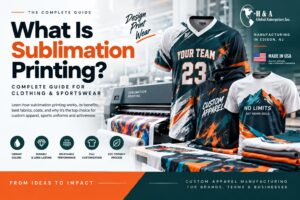
Sublimation uses heat to turn dye into a gas that bonds directly into polyester fibers. The design doesn’t sit on the fabric — it becomes part of it. That’s why sublimated jerseys can be covered edge-to-edge in color, numbers, and sponsor logos without adding any weight or stiffness.
Strengths:
- Unlimited colors and full-bleed, all-over designs at no extra cost per color
- Print never cracks, peels, or fades — it’s literally in the fibers
- Zero hand-feel; the garment performs exactly like unprinted fabric
Limitations:
- Only works on white or light-colored polyester and poly-blend fabric
- Not viable on cotton or dark base garments
- Requires higher minimum order quantities to be cost-effective
Best for: athletic jerseys, esports uniforms, team practice gear, and any design that needs full-color graphics without weighing down the fabric.
DTF: Built for Flexibility and Small Runs
Direct-to-film printing prints your design onto a special film, then heat-presses it onto the garment. It’s the newest of the three methods and has quickly become the go-to for orders that don’t fit neatly into embroidery or sublimation.
Strengths:
- Works on cotton, polyester, blends, and dark-colored garments
- Handles photo-realistic detail and gradients well
- Cost-effective at lower quantities compared to sublimation
Limitations:
- Print sits on top of the fabric, so it has more hand-feel than sublimation
- Durability is good but generally falls short of embroidery or sublimation over years of heavy wash cycles
- Not ideal for full-garment, edge-to-edge designs the way sublimation is
Best for: event t-shirts, fan gear, small-batch team orders, and designs that need to go on cotton or dark fabric.
Side-by-Side Comparison
| Embroidery | Sublimation | DTF | |
|---|---|---|---|
| Best fabric | Polos, caps, outerwear | Light polyester | Cotton, blends, dark garments |
| Full-color designs | Limited | Yes, unlimited | Yes |
| Durability | Highest | Highest | Good |
| Hand-feel | Textured | None (in-fabric) | Slight |
| Minimum order | Low | Higher | Low |
| Typical use | Logos, text | Team jerseys | Event tees, small runs |
So Which One Does Your Order Need?
Ask three questions before you request a quote:
- What’s the fabric? Polyester jersey → sublimation. Cotton or a blend → DTF or embroidery.
- How much of the garment is covered? Small logo → embroidery. Full-color, all-over design → sublimation or DTF.
- What’s the order size? Larger team orders on polyester → sublimation is most cost-effective. Smaller or mixed-garment runs → DTF.
Most teams and brands actually end up using more than one method across a single order — embroidered logos on the polos and warm-ups, sublimated designs on the game jerseys. A manufacturer that runs all three in-house can make that call for you instead of forcing your whole order into whichever method they happen to offer.
Get a Recommendation, Not Just a Quote
H&A Global Enterprises runs cut & sew, embroidery, sublimation, and DTF production out of our Edison, New Jersey facility, so you’re not stuck choosing a method before you know which one actually fits your garment and budget. Tell us what you’re building and we’ll tell you which process gets you there.