Starting an activewear brand can look deceptively simple from the outside.
Create a logo. Find a manufacturer. Put your branding on leggings, jerseys, shorts, or performance shirts. Build a website. Post a few videos on social media. Start selling.
In reality, building an activewear brand that customers actually want to buy requires much more.
You need to understand your market, choose the right products, develop reliable samples, select fabrics that perform as expected, calculate your true costs, find the right manufacturing partner, manage minimum order quantities, create a pricing strategy, build your sales channels, and eventually develop an operation capable of fulfilling and scaling orders.
The good news is that you do not need to become Nike on day one.
In fact, trying to launch too many products, order too much inventory, or appeal to everyone can make starting an activewear business unnecessarily expensive.
A smarter approach is to start focused.
Build a specific product for a specific customer. Validate it. Improve it. Establish a reliable production process. Build demand. Then expand.
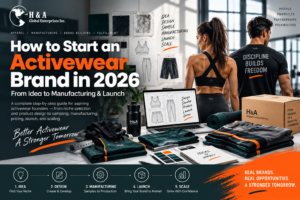
This guide walks through that entire process—from your first idea to manufacturing, launch, fulfillment, and eventually scaling your activewear brand.
1. Choose Your Activewear Niche
One of the first mistakes new founders make is defining their audience as simply “people who work out.”
That market is enormous, but it is not a useful target customer.
Think about the difference between someone buying clothing for yoga and someone buying apparel for competitive powerlifting.
Their expectations may be completely different.
Your niche could focus on:
- Running
- Cross-training
- Yoga
- Cycling
- Bodybuilding
- Powerlifting
- Pickleball
- Tennis
- Golf
- Soccer
- Basketball
- Baseball
- Football
- Wrestling
- Outdoor fitness
- Women’s training apparel
- Modest activewear
- Plus-size performance apparel
- Youth sports
- Teamwear
- Athleisure
You can narrow the market even further.
Instead of launching another general “gym clothing company,” you might build a brand specifically for female powerlifters who struggle to find performance apparel with the fit and durability they need.
That immediately gives your brand a stronger purpose.
Your niche affects almost everything that follows: fabrics, garment construction, sizing, designs, pricing, branding, marketing, and even which manufacturer is appropriate.
Find a problem, not just a category
Ask:
What is frustrating customers about the activewear they already own?
Maybe running shorts lack useful storage.
Perhaps gym shirts retain too much moisture.
Maybe larger athletes struggle with inconsistent sizing.
Perhaps wrestling teams want better customization.
Maybe smaller fitness clubs cannot meet the minimum quantities demanded by large manufacturers.
Those frustrations represent opportunities.
A successful activewear brand doesn’t necessarily need to invent an entirely new category. It can simply solve an existing problem better for a specific group of people.
2. Define Your Target Customer
Once you know your niche, create a clear picture of the person most likely to buy your products.
Don’t stop at age and gender.
Understand their behavior.
Suppose you’re launching a premium strength-training brand.
Your target customer might be:
A 22–35-year-old strength-training enthusiast who trains four or five times per week, follows fitness creators online, values durable performance clothing, and is willing to spend more on apparel designed specifically for serious training.
Now you can make much better decisions.
Ask:
Where do they train?
Which brands do they already buy?
How much do they normally spend?
Which social platforms do they use?
What complaints do they have about existing products?
Do they care more about appearance, comfort, performance, sustainability, price, or exclusivity?
Talk to actual potential customers whenever possible.
Ten genuine conversations with people in your target market can sometimes reveal more useful information than hours spent guessing behind a laptop.
3. Research Your Competitors
Competition isn’t necessarily evidence that you should avoid a market.
It is often evidence that people are already willing to spend money there.
Study both large and emerging activewear brands.
Look at:
- Product selection
- Pricing
- Materials
- Sizing
- Color options
- Customer reviews
- Social media
- Brand positioning
- Shipping policies
- Promotions
- Packaging
- Product photography
- Community strategy
Pay particular attention to negative reviews.
A competitor’s one-star and three-star reviews can become extremely useful product research.
Customers might repeatedly complain that:
“The leggings become transparent when stretched.”
“The shorts ride up during training.”
“The sizing runs extremely small.”
“The logo started peeling after three washes.”
“There are no pockets.”
Those aren’t simply complaints.
They are product-development information.
Don’t build a copy
Competitor research should help you identify opportunities—not create a slightly different version of someone else’s brand.
Ask:
What can we do that gives customers a real reason to switch?
Your advantage might come from the product itself, customization, community, service, sizing, niche specialization, local production, turnaround time, or an entirely different business model.
4. Decide What Products to Launch
You don’t need 30 products for your first collection.
More products mean more samples, more sizes, more colors, more inventory, more photography, more product pages, and more capital tied up before you know what customers actually want.
Start with a focused collection.
For example:
Women’s training brand
- Performance leggings
- Sports bra
- Training top
Men’s gym brand
- Performance T-shirt
- Training shorts
- Oversized pump cover
Running brand
- Running shorts
- Moisture-wicking top
- Lightweight jacket
A hero product can be even more effective.
Build one product people associate with your company, establish demand, and then expand around it.
A smaller first collection also lets you spend more time getting the important details right.
5. Create Your Brand Identity
Your brand is more than a logo.
It includes how customers perceive your business and what they expect from it.
Define your:
Brand purpose — Why does this company exist?
Positioning — Who specifically is it for?
Personality — Serious? Aggressive? Premium? Inclusive? Minimalist? Community-driven?
Visual identity — Logo, colors, typography and imagery.
Voice — How does the company communicate?
Promise — What should customers consistently expect?
Consider two hypothetical companies.
One says:
“Premium activewear for everyone.”
Another says:
“Training apparel engineered for women who lift heavy.”
The second is much easier to understand and remember.
Specific positioning often gives smaller companies an advantage because large brands typically have to communicate to broader markets.
6. Private Label vs. Fully Custom Activewear
One of the biggest early manufacturing decisions is determining how customized your product needs to be.
Private label activewear
Private labeling generally involves selecting an existing or relatively standardized garment and selling it under your own brand, potentially with customized labels, decoration, packaging, or other modifications.
Advantages can include:
- Faster development
- Lower initial complexity
- Reduced development costs
- Easier testing
- Potentially smaller order requirements
It can be appropriate for founders who want to enter the market quickly and validate demand.
Fully custom manufacturing
Custom manufacturing gives you much more control.
You can potentially specify:
- Fabric
- Construction
- Panels
- Measurements
- Pockets
- Waistbands
- Zippers
- Seams
- Colors
- Prints
- Labels
- Trims
- Finishing
The tradeoff is additional development work, sampling, cost, and usually more manufacturing complexity.
Neither approach is automatically better.
The correct choice depends on your product, differentiation, budget, timeline, and business strategy.
7. Create Your Designs and Tech Packs
Once you’ve decided what you’re making, the idea has to become something a manufacturer can actually produce.
A sketch alone usually isn’t enough for a fully customized garment.
This is where a tech pack becomes valuable.
A tech pack communicates the technical specifications of a product to the manufacturer.
Depending on the garment, it may include:
- Front and back technical drawings
- Measurements
- Size specifications
- Fabric requirements
- Construction details
- Stitching
- Artwork placement
- Logo dimensions
- Color references
- Labels
- Trims
- Packaging requirements
Think of it as a blueprint.
“Make the pocket a little bigger” is subjective.
“Pocket opening: 6.5 inches” is measurable.
Clear specifications reduce misunderstandings between designers, founders, and production teams.
The better the information going into product development, the better your chances of receiving a sample that resembles what you imagined.
8. Find the Right Activewear Manufacturer
Finding a manufacturer shouldn’t be reduced to asking:
“Who has the cheapest price?”
The cheapest quotation can become very expensive if you receive inconsistent quality, missed deadlines, poor communication, or unusable inventory.
Evaluate manufacturers based on factors such as:
- Experience with your product category
- Fabric capabilities
- Minimum order quantities
- Sampling
- Production capacity
- Quality-control processes
- Decoration capabilities
- Communication
- Lead times
- Pricing
- Packaging
- Shipping
- Location
Activewear also creates technical requirements that ordinary fashion products may not have.
Performance garments may need to deal with stretching, sweat, friction, repeated washing, intensive movement, and different environmental conditions.
A manufacturer experienced in performance apparel can therefore be particularly valuable.
Domestic vs. overseas manufacturing
There isn’t one universally correct answer.
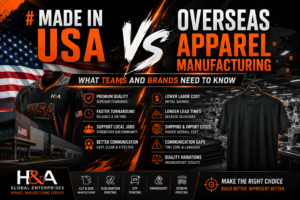
Domestic manufacturing can offer advantages such as easier communication, potentially faster sampling or transportation, and easier physical access to the production process.
Overseas manufacturing can sometimes provide attractive pricing or access to enormous production ecosystems.
But you should evaluate the complete supply chain, not simply the quoted unit cost.
Factor in shipping, duties where applicable, lead time, minimum quantities, communication, quality control, and the financial impact of holding inventory.
9. Understand MOQ
MOQ means minimum order quantity.
A manufacturer may require a minimum number of units before accepting a production order.
Why?
Production involves setup.
Fabric needs to be sourced. Machines and workflows may need to be configured. Artwork may need preparation. Cutting and sewing operations have to be scheduled.
Producing one garment can therefore be disproportionately expensive.
But MOQ can create a major problem for startups.
Imagine a manufacturer requires 500 units.
You want:
5 sizes × 4 colors.
If that minimum applies across individual styles or colors, your inventory requirements can quickly become much larger than expected.
Before agreeing to production, ask exactly how the MOQ works:
- Per design?
- Per style?
- Per color?
- Per size?
- Across the complete order?
Don’t assume.
A slightly higher per-unit price at a manageable MOQ can sometimes be financially safer for a new brand than chasing the lowest possible unit price and purchasing inventory it cannot sell.
10. Develop Your First Samples
Don’t rush from concept directly into bulk production.
Sampling is where your idea meets reality.
Your first sample may reveal issues you never noticed on a screen.
Maybe:
- The sleeve opening is too tight.
- The shorts are too long.
- The fabric feels heavier than expected.
- The logo is positioned incorrectly.
- The waistband rolls.
- The zipper feels cheap.
- The colors don’t match.
- The garment fits differently from your intended silhouette.
That’s normal.
Sampling is part of product development.
Document every change clearly.
Instead of:
“Make this tighter.”
Specify exactly what needs changing and, where possible, by how much.
Keep versions of your samples and technical specifications so you can track what changed between revisions.
11. Test Fit, Fabric and Performance
A sample looking good in a photograph does not mean it’s ready for production.
Activewear needs real-world testing.
Have people from your intended customer group wear it.
Test relevant activities.
For leggings, you may examine:
- Stretch
- Opacity
- Waistband stability
- Seam comfort
- Moisture behavior
- Recovery after stretching
For running apparel:
- Chafing
- Breathability
- Movement
- Weight
- Pocket stability
For team uniforms:
- Range of motion
- Print durability
- Fit
- Comfort
- Repeated washing
Wash samples repeatedly according to the intended care instructions.
Check whether:
- Colors fade
- Prints crack
- Embroidery distorts
- Fabric shrinks
- Seams change
- Labels become uncomfortable
- Garments lose shape
It is much cheaper to discover a problem during sampling than after hundreds of units have been manufactured.
12. Calculate Your Product Costs
One of the most dangerous startup mistakes is confusing manufacturing cost with total cost.
Suppose your manufacturer charges $15 for a garment.
That does not necessarily mean your landed product cost is $15.
Depending on your operation, you may also have:
- Sampling costs
- Labels
- Hangtags
- Packaging
- Freight
- Customs or duties
- Warehousing
- Fulfillment
- Payment processing
- Returns
- Damaged products
- Software
- Marketing
Calculate your landed cost as accurately as possible.
Then model your gross margin.
For example, if your landed cost is $20 and your retail price is $60:
$60 – $20 = $40 gross profit before other operating expenses.
That does not mean you’ve made $40 in net profit.
Marketing, transaction fees, fulfillment, salaries, software, returns, discounts, and overhead can still consume part of that margin.
Know your numbers before placing a large order.
13. Price Your Activewear
Pricing shouldn’t be based entirely on:
“My competitor charges $50, so I’ll charge $45.”
Your price has to work economically while fitting your market positioning.
Consider:
- Landed cost
- Desired margin
- Competitor pricing
- Customer willingness to pay
- Brand positioning
- Promotional discounts
- Returns
- Fulfillment
- Future wholesale opportunities
If you plan to eventually sell through retailers or dealers, your economics may need enough margin to support wholesale pricing as well.
Constant discounting can also weaken a brand.
A company that launches at $70 but is permanently “40% off” eventually teaches customers that $42 is the real price.
Build pricing intentionally from the beginning.
14. Plan Your First Production Run
Your first production run is not the time to prove how confident you are.
It’s the time to manage risk.
Use whatever evidence you have:
- Customer interviews
- Waitlists
- Pre-orders
- Sample feedback
- Social engagement
- Email subscribers
- Previous sales
- Comparable products
Think carefully about size distribution as well.
Ordering equal quantities of XS, S, M, L, XL, and XXL may look tidy on a spreadsheet but might not reflect actual customer demand.
The goal isn’t merely to sell out.
Selling out in three hours while hundreds of customers wanted the product can mean you under-ordered.
Holding inventory for two years means you probably over-ordered.
Over time, actual sales data will make forecasting easier.
15. Packaging and Branding
The product experience doesn’t end when manufacturing finishes.
Customers experience:
- Packaging
- Labels
- Hangtags
- Inserts
- Shipping materials
- Emails
- Delivery
- Unboxing
Packaging should reinforce your positioning without destroying your margin.
A startup doesn’t necessarily need an elaborate luxury box for a $35 training shirt.
Start with what adds meaningful value.
Make sure your garments also contain any labeling required for the markets where you sell.
Your packaging should feel intentional, protect the product, and create a consistent customer experience.
16. Warehousing and Fulfillment
At very small volumes, founders often fulfill orders themselves.
That’s reasonable.
You may store inventory in a spare room, print labels, pack orders, and drop packages off yourself.
But growth changes the equation.
At 10 orders a week, self-fulfillment is manageable.
At hundreds or thousands of orders, fulfillment can become an operation of its own.
You’ll need to manage:
- Inventory receiving
- Storage
- Picking
- Packing
- Shipping
- Tracking
- Exchanges
- Returns
- Inventory accuracy
At some point, outsourcing fulfillment may allow you to spend more time on product development, sales, marketing, and strategy.
Think about fulfillment before a successful launch creates an operational problem.
17. Build Your Online Store
Your website doesn’t need dozens of complex features.
It needs to make customers comfortable buying.
At minimum, customers should easily understand:
What are you selling?
Who is it for?
Why is it different?
How much does it cost?
What size should I buy?
When will it arrive?
Can I return it?
Strong product pages should include:
- Clear photography
- Product benefits
- Material information
- Fit guidance
- Size chart
- Care instructions
- Shipping information
- Returns information
- Reviews when available
Avoid writing descriptions that only say:
Premium quality. Maximum comfort. Best performance.
Those statements could describe thousands of products.
Explain specifically why the garment performs differently.
18. Create a Pre-Launch Strategy
Don’t wait until inventory arrives before trying to find customers.
Start building your audience during product development.
Document the journey.
Show:
- Sketches
- Samples
- Fabric selection
- Testing
- Packaging
- Production
- Founder stories
- Mistakes
- Improvements
- Behind-the-scenes work
This gives people a reason to follow the brand before they can even purchase.
Build an email list as early as possible.
You might offer:
- Early access
- Launch pricing
- Limited first drops
- Giveaways
- Founder updates
- VIP access
Micro-creators can also be useful.
Instead of immediately spending your entire marketing budget on a celebrity or enormous influencer, work with creators who have genuine relationships with the niche you’re targeting.
Twenty highly relevant creators can sometimes produce better outcomes than one enormous but poorly matched audience.
19. Launch Your Collection
Launch day should be the result of preparation, not the beginning of marketing.
Before launching, verify:
- Inventory
- Product pages
- Pricing
- Discount codes
- Email automations
- Analytics
- Payment processing
- Shipping settings
- Returns process
- Customer support
- Mobile checkout
Test the entire customer journey yourself.
Place a test order.
Read every email.
Open the website on multiple devices.
Test checkout.
Make sure inventory deducts correctly.
Then launch to your warmest audience first.
Your email subscribers, early supporters, community members, creators, and existing network are more likely to provide the first sales and valuable feedback.
Your first launch is also research
Pay attention to more than revenue.
Look at:
- Conversion rate
- Best-selling product
- Best-selling size
- Best-selling color
- Average order value
- Return rate
- Customer questions
- Traffic sources
- Repeat purchases
The first collection gives you information for making the second one better.
20. Scale Production
Eventually, the challenge changes.
At the beginning, you’re asking:
“Can I get people to buy this?”
Later, you’re asking:
“Can our operation reliably support this demand?”
Scaling an apparel business can introduce completely different problems.
You may need:
- Larger production runs
- Better forecasting
- More reliable suppliers
- Additional quality control
- Warehousing
- Fulfillment infrastructure
- Inventory systems
- Customer support
- Wholesale distribution
- New sales channels
Don’t mistake higher revenue for healthy scaling.
If sales triple while returns, inventory mistakes, production delays, and customer complaints increase fivefold, you haven’t created a stronger business.
You’ve created a larger problem.
Scale what has already been validated
If one product consistently sells, consider expanding around it.
Suppose your hero product is a pair of performance shorts.
Expansion might look like:
Stage 1: Performance shorts
Stage 2: Additional colors
Stage 3: Matching performance top
Stage 4: Lightweight jacket
Stage 5: Complete collection
This is often safer than continuously launching unrelated products.
Scaling should also give you better information.
As order volume grows, you can better understand:
- Which sizes sell
- Which colors perform
- Seasonal demand
- Repeat purchase behavior
- Return patterns
- Customer acquisition costs
- Product margins
- Inventory turnover
Use that data to make increasingly informed production decisions.
From an Activewear Idea to an Actual Business
The biggest lesson for aspiring activewear founders is simple:
A brand is not just a logo placed on a garment.
You’re building a system.
The idea has to become a design.
The design has to become a sample.
The sample has to become a reliable production specification.
Production has to become inventory.
Inventory has to reach customers.
Customers have to receive a product good enough to purchase again and recommend to others.
And eventually, the entire system has to operate at greater volume without sacrificing the quality that created demand in the first place.
That is why the manufacturing and operational decisions you make early can have such a significant impact later.
Building an Apparel Brand? H&A Can Help You Move From Idea to Scale
Starting an activewear company means solving dozens of interconnected challenges—product development, sampling, manufacturing, branding, inventory, logistics, fulfillment, and eventually growth.
Trying to coordinate every stage through unrelated vendors can become difficult, particularly for first-time founders.
The H&A Brand Accelerator is designed to help apparel entrepreneurs move through these stages with manufacturing and operational support under a more connected ecosystem.
Whether you’re developing your first product or preparing to scale an existing apparel company, the goal is to remove some of the operational barriers between an idea and a commercially viable brand.
Explore the H&A Brand Accelerator →
Frequently Asked Questions About Starting an Activewear Brand
How much does it cost to start an activewear brand?
There is no universal startup cost.
A small private-label launch can require substantially less capital than developing multiple completely custom garments from scratch.
Your budget can include product development, samples, manufacturing, branding, packaging, freight, website development, photography, marketing, warehousing, and fulfillment.
Instead of asking only, “How much money do I need?”, ask:
What is the smallest commercially viable version of my brand that lets me test real customer demand?
That can prevent unnecessary spending.
Can I start an activewear brand with a small budget?
Yes, but a small budget makes focus especially important.
Consider launching fewer products, limiting color variations, choosing manageable quantities, and validating demand before committing to large inventory purchases.
A focused launch with three excellent products can be much stronger than a 20-product collection where development and marketing budgets are spread too thinly.
Do I need to design my activewear myself?
Not necessarily.
You can work with apparel designers, technical designers, product developers, or manufacturers that offer development assistance.
However, you should still have a clear understanding of your intended customer, product requirements, and differentiation.
A designer can translate your idea into a product, but they shouldn’t have to invent the entire business concept for you.
What is the difference between private label and custom activewear?
Private-label products typically use existing or standardized products that are sold under your branding, potentially with customization.
Fully custom manufacturing allows substantially greater control over fabrics, measurements, construction, features, colors, trims, and other product specifications.
Private labeling can provide a faster route to market, while custom development can provide greater differentiation.
What is MOQ in activewear manufacturing?
MOQ stands for minimum order quantity.
It is the minimum quantity a manufacturer requires for an order, style, color, or other production configuration.
Always ask how the manufacturer calculates its MOQ because the rules can significantly affect your total inventory investment.
Should I manufacture activewear in the USA or overseas?
Both approaches can work.
Your decision should consider much more than unit price.
Evaluate production capabilities, MOQ, sampling, communication, quality, lead times, freight, duties, inventory requirements, and your overall supply-chain strategy.
The cheapest factory quote isn’t necessarily the lowest-cost business decision.
How long does it take to launch an activewear brand?
The timeline varies considerably.
Private-label products may allow faster launches, while completely custom products can require multiple rounds of development and sampling before bulk production.
Manufacturing capacity, material availability, order volume, shipping method, revisions, and quality requirements can all affect timing.
Build contingency time into your launch plan rather than promising customers a date based on the best-case production scenario.
How many products should my activewear brand launch with?
There is no required number.
For many new brands, a focused collection is preferable.
You might launch with one hero product or a small collection of two to five complementary products.
The objective is to create enough choice to establish a brand while avoiding unnecessary inventory complexity.
Do I need a tech pack?
If you’re developing a fully custom garment, a detailed tech pack is highly recommended.
It gives the manufacturer measurable specifications covering areas such as construction, dimensions, fabrics, artwork, labels, trims, and finishing.
For straightforward private-label products, the technical development requirements may be much simpler.
How do I find a reliable activewear manufacturer?
Look beyond price.
Evaluate the manufacturer’s experience with your product category, previous work, sampling process, communication, production capabilities, minimum quantities, quality-control procedures, lead times, and ability to support your expected growth.
Always sample before committing to significant bulk production.
Can I start selling before bulk production is complete?
Some brands use pre-orders to validate demand before producing significant inventory.
However, customers must receive clear and realistic information about expected delivery times.
Pre-orders should not be used to make promises based on production timelines that haven’t been properly confirmed.
What is the biggest mistake new activewear brands make?
There isn’t only one, but a common pattern is investing heavily before validating the product and customer.
Founders can spend substantial amounts on inventory, packaging, websites, photography, and marketing before knowing whether customers actually want the product.
Start with a clear niche, test your assumptions, develop and test samples, understand your economics, and expand based on evidence.
Is the activewear market too competitive to enter in 2026?
The activewear industry is competitive, but competition alone doesn’t mean there is no opportunity.
Trying to become another generic activewear company is much harder than building for an underserved customer, sport, community, use case, or product problem.
You don’t need every activewear customer.
You need a specific group of customers to believe that your product was designed specifically for them.
How can I make my activewear brand stand out?
Start with meaningful differentiation rather than cosmetic differentiation.
Changing a logo or choosing different colors is easy for competitors to copy.
Stronger differentiation can come from:
- Specialized fit
- Better functionality
- A specific sport or activity
- Underserved sizing
- Distinctive product design
- Community
- Customization
- Superior customer experience
- Better manufacturing
- Faster service
- A compelling brand story
Ideally, your customer should be able to explain why they chose you instead of another company.
Start Small. Learn Fast. Build for Scale.
You don’t need to launch with dozens of products, thousands of units, celebrity endorsements, or a massive advertising budget.
You need a product that solves a real problem for a clearly defined customer.
Start there.
Develop it carefully.
Test it.
Understand your costs.
Build the audience before launch.
Listen to customers after launch.
Then use real demand—not assumptions—to determine what you manufacture next.
Because ultimately, the goal isn’t simply to start an activewear brand in 2026.
It’s to build one that customers want to come back to.
Have an activewear concept you’re ready to turn into a real product? Explore the H&A Brand Accelerator and discover a path from product development and manufacturing to fulfillment and growth.