If you’re building an apparel or sportswear brand, chances are you’ve hit this question already: should this run through cut and sew manufacturing, or through sublimation printing? People throw these terms around like they’re competing options, but honestly, they’re not answering the same question at all. Mixing them up is one of the most common (and costly) mistakes we see from new brands.
We run both processes in-house at our facility in Edison, New Jersey, so we’re not trying to push you toward one or the other here. We just want you to walk away knowing which one your project actually needs.
Cut and Sew: Building the Garment Itself
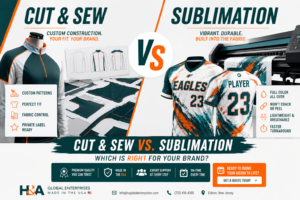
Cut and sew is how a garment gets made from scratch. Fabric gets sourced, patterns get drafted, panels get cut, and a sewing team assembles the whole thing piece by piece. It’s construction, not decoration.
You’ll want this route if:
- You’re designing something original — a new silhouette, unusual paneling, a fit nobody else has
- Off-the-shelf blanks just don’t capture what your brand is trying to do
- You care about the details — seam type, fabric weight, trim choices — and want a say in all of it
- You’re building a premium or performance line where the construction is half the value proposition
We break down the whole process, from pattern making to quality control, on our Cut and Sew Manufacturer page if you want the specifics.
Sublimation: Getting the Design Into the Fabric
Sublimation doesn’t build anything — it decorates what’s already there. Dye gets turned into gas under heat and pressure, then bonds permanently into the fabric fibers. The result is vivid, full-color graphics that won’t crack or peel, no matter how many wash cycles you put them through.
This is the better fit when:
- Your design has bold, all-over graphics or gradients that screen printing or embroidery can’t realistically pull off
- You’re producing team uniforms or performance wear where the artwork needs to live in the fabric, not sit on top of it
- Breathability matters and you can’t afford any added texture or weight
- The garment itself is already decided, and the design is what you’re really focused on
More detail on how we handle it lives on our Sublimation Printing Manufacturer page.
Where People Get Confused
Here’s the thing that trips most brands up: cut and sew and sublimation aren’t rivals, they’re just answering different parts of the same project. One shapes the garment. The other colors it. A brand can absolutely need both — and a lot of our best work happens exactly there.
Take a sports uniform brand as an example. They might come to us wanting a fully custom cut and sew build, then have us sublimate the fabric panels before assembly so the artwork carries seamlessly across every seam. No visible breaks in the design, no mismatched patterns at the shoulder or side seam. That’s a big part of what our sublimated sports uniform work looks like day to day out of the Edison facility.
| Cut and Sew | Sublimation | |
|---|---|---|
| Determines garment shape/fit | Yes | No |
| Determines the artwork/finish | Sometimes, if printing before assembly | Yes |
| Best for custom silhouettes | Yes | No |
| Best for vibrant, all-over graphics | Depends on the process used | Yes |
| Typical use | Custom fashion, premium apparel, unique fits | Sports uniforms, team wear, all-over prints |
Figuring Out What You Actually Need
A few honest questions to ask yourself before you decide anything:
Are you designing something new, or dressing up something that already exists? New shape or fit means cut and sew. Working off a blank you already like means sublimation is probably enough.
What does the design itself demand? Simple logos or solid colors can go on a stock blank without much fuss. Bold, edge-to-edge, multi-color artwork usually needs sublimation to look right and hold up.
What’s your volume, and what’s your budget? Cut and sew involves pattern development and tooling upfront, so it tends to make more financial sense once you’re producing at moderate-to-large volume. Sublimating a pre-made blank can be the smarter move for a smaller first run, or if you’re still testing whether a design resonates before committing further.
Most Brands End Up Doing Both
The brands we’ve worked with the longest rarely pick one process and stop there. They lean on cut and sew to get the fit and construction right, and sublimation to make sure nobody scrolls past the design. Handling both under one roof also means one point of contact, one production timeline, and no finger-pointing between separate vendors if something needs adjusting.
Not Sure Which Way to Go? Ask Us Before You Commit
If you’re still weighing this, send us your designs and we’ll tell you plainly what it’ll take to produce them — no pressure, no sales pitch, just a straight answer.
Book a Free Consultation or take a look at our full range of manufacturing services to see everything we handle in-house